Practical guide for HR teams

Employee recognition programme examples people can understand.

A good programme makes everyday appreciation easy and higher-value awards fair. Use these examples to shape your badges, spot awards, nominations, budgets and recognition cadence—then adapt the details to your culture.

Recognition formats

Choose when a thank you, badge, award or Spotlight fits.

Fair programme rules

Set criteria, eligibility, approvals and cadence.

Reward decisions

Separate appreciation from points and budgeted awards.

1 · Design the programme

Start with the behaviour—not the badge.

Before choosing employee recognition programme names, decide what the programme should make easier. Every category needs a clear job, or employees will not know which one to use.

01

Purpose

Write the behaviour, contribution or moment each format exists to recognise.

02

Eligibility

State who can give, receive and approve each type of recognition.

03

Evidence

Ask for a specific action and impact instead of broad praise alone.

04

Cadence

Keep peer appreciation available every day and define review cycles for major awards.

05

Reward value

Decide which moments are non-monetary and which use points or budget.

06

Visibility

Choose what belongs on Culture Wall, in Spotlight or on Wall of Fame.

2 · Choose the right format

Not every thank you needs to
become an award.

A useful employee rewards and recognition programme gives people a small number of distinct choices. That keeps frequent appreciation light while protecting the meaning of formal awards.

Everyday appreciation

A timely message from a peer or manager. Best for helpful actions worth acknowledging now.

Values-led badges

A repeatable way to connect appreciation with the behaviours your organisation values.

Manager awards

Structured recognition with defined criteria, optional approval and possible reward points.

Spot awards

Prompt recognition for an exceptional contribution, with eligibility and budget rules set in advance.

Spotlight and milestones

More visible recognition for achievements, anniversaries, project moments or team celebrations.

3 · Employee award examples

Six starting ideas you can customise.

These are illustrative employee recognition award names and criteria—not a fixed ExtraMile catalogue. Keep the names that sound natural in your organisation and rewrite the criteria around your own values.

Peer appreciation

Everyday Thank You

A quick, specific appreciation for a colleague who helped work move forward.

Example criterion

Name the action, who it helped and why it mattered.


Values badge

Better Together

Recognise collaboration across roles, locations or teams.

Example criterion

Use when someone shares context, removes a blocker or supports a joint outcome.

Manager award

Idea Catalyst

Celebrate a useful idea that improves a process, experience or result.

Example criterion

Describe the idea and the change it created or could create.


Spot award

Above & Beyond

Reward an exceptional contribution close to the moment it happens.

Example criterion

Keep eligibility and approval rules clear before adding points or reward value.


Customer award

Customer Champion

Highlight work that improves a customer or participant experience.

Example criterion

Connect the nomination to a specific customer need, action and outcome.


Milestone recognition

Milestone Moment

Mark work anniversaries, project milestones or meaningful team moments.

Example criterion

Add a personal message so the recognition feels more human than an automated alert.


4 · Make it visible

Use Spotlight for focus. Use Culture Wall for continuity.

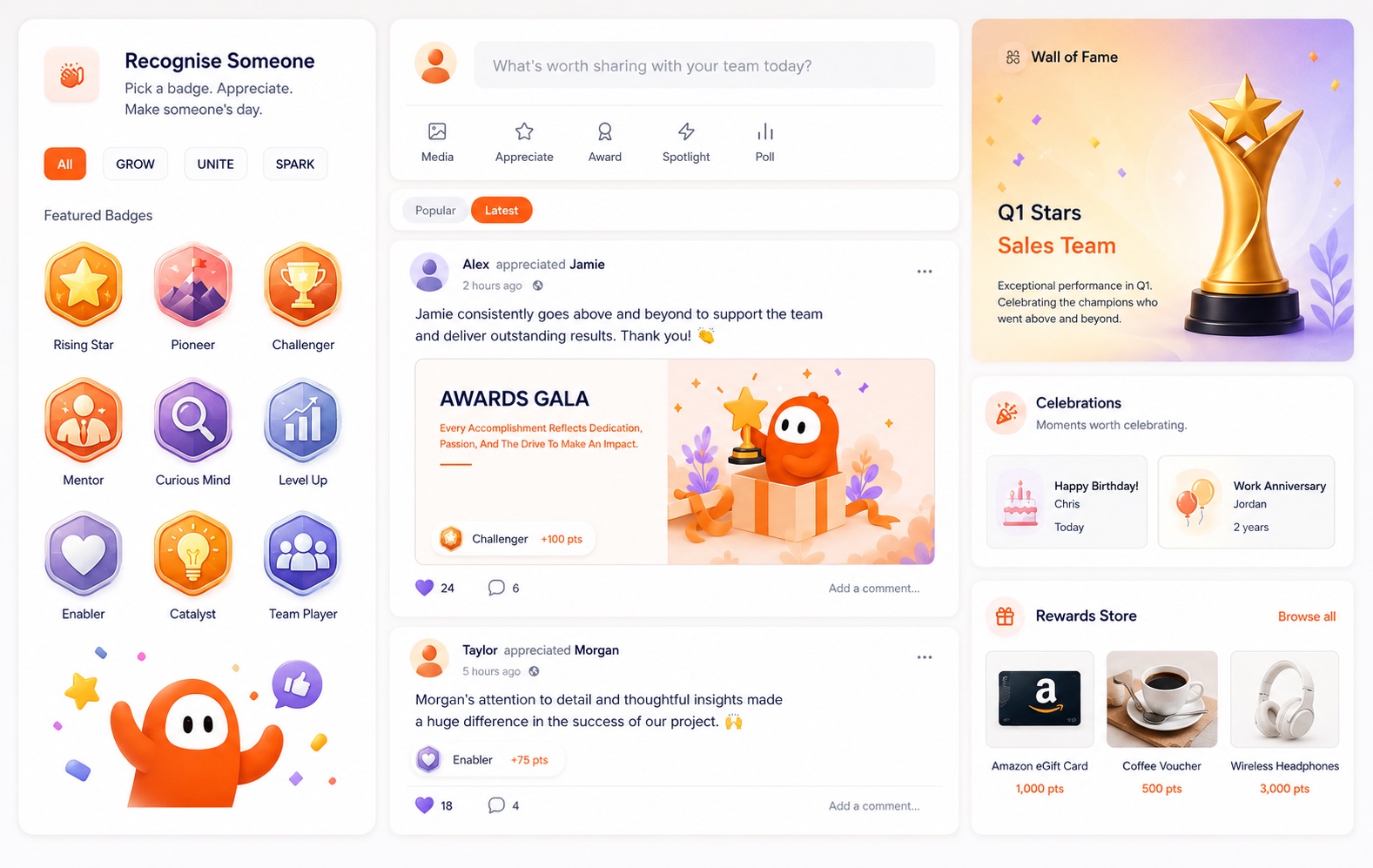
Culture Wall can hold the everyday rhythm: appreciation, badges, awards and celebrations. Spotlight and Wall of Fame can bring selected achievements forward without making every post feel like a major announcement.

5. Fair nominations

Make the nomination easy to write and easy to review.

A fair process does not need to feel heavy. Ask for the same useful details every time, then apply the same approval rule to every eligible nomination

1

Notice the contribution

A peer or manager sees work
worth recognising.

2

Choose the right format

Give appreciation, an award, a
Spotlight or a team celebration.

3

Add context and review

Explain the contribution and
apply an approval step when
the award requires one.

4

Publish, reward and measure

Share the moment while points,
budgets, wallet activity and
programme signals stay connected.

A useful monthly review: look for teams, roles, locations or kinds of work that may be under-recognised. Recognition activity is a signal to examine—not proof of performance by itself.

6 · Reward design

Decide when recognition should carry points.

Recognition without points

Keep frequent appreciation human.

Use messages, values badges, team celebrations and milestone posts when visibility and sincerity are the value.

Recognition without points

Keep frequent appreciation human.

Use messages, values badges, team celebrations and milestone posts when visibility and sincerity are the value.

7 · Rollout checklist

A simple recognition programme checklist.

Start small enough to explain in one conversation. You can expand once employees use the first set consistently.

Move from the framework to the workflow

See how ExtraMile brings the programme together.

Explore employee rewards and recognition software for Culture Wall, appreciation, badges, awards, points, budgets, Spotlight, Wall of Fame and the employee rewards Shop.

Questions HR teams ask

Employee recognition programme FAQs.

What should an employee recognition programme include?

A useful programme defines the behaviours and contributions being recognised, who can nominate, who is eligible, whether approval is needed, how often recognition happens, what budget applies and where recognised moments are visible.

Peer recognition is usually a frequent appreciation from one colleague to another. A spot award is commonly a manager-led or approval-based reward for a specific contribution and may include points or monetary value.

Start with a small set employees and managers can distinguish easily. A mix of everyday appreciation, values-led badges, a manager award, a spot award and milestone recognition is often clearer than a long catalogue of overlapping awards.

No. A sincere public appreciation or values badge can be meaningful without points. Reserve reward value for clearly defined awards and use budgets and approval rules where financial value is attached.

Publish eligibility and criteria, ask for evidence tied to the criteria, make approvals consistent, review recognition patterns and check whether teams, locations or work types are being overlooked.