
By Pooja Bajaj, Founder & CEO – ExtraMile
Here is the most common thing I hear from HR leaders after a successful engagement event.
“The team loved it. But I have no idea how to prove that to my CFO.”
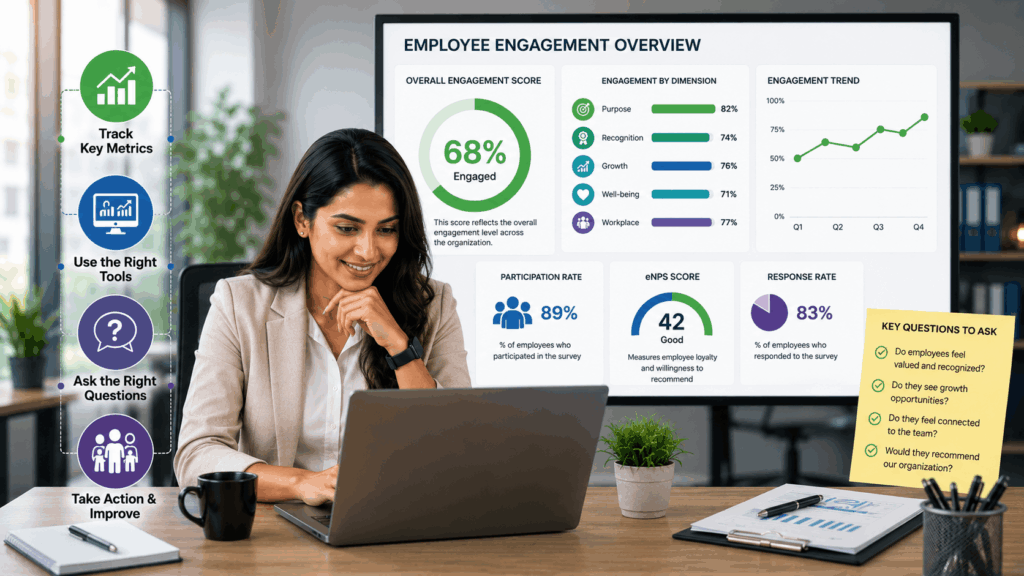
This is the engagement measurement gap, and it is one of the most significant challenges facing HR teams in India today.
Running employee engagement programs is one thing. Knowing whether they are actually working, and being able to demonstrate that to leadership, is another entirely.
So let us talk about how to actually measure engagement.
The 3 Types of Engagement Data
Not all engagement data is the same. You need three types working together.
Perception data, what employees say they feel. Surveys, pulse checks, one-on-ones. This tells you attitude.
Behavioural data, what employees actually do. Participation rates in programs, absenteeism, voluntary turnover. This tells you action.
Outcome data, what the business sees as a result. Productivity, quality, customer satisfaction, attrition cost. This tells you impact.
Most HR teams track perception data (surveys) and outcome data (attrition), but miss behavioural data entirely. That middle layer is where engagement actually lives day to day.
The 5 Metrics That Matter Most
Employee Net Promoter Score (eNPS), one question: “How likely are you to recommend this organisation as a place to work?” Scale of 0–10. Simple, benchmarkable, and highly predictive of retention. Run it quarterly.
Participation Rate, what percentage of employees are actively engaging with your programs, events, and initiatives? Low participation is an early warning signal. Track it by team, department, and location.
Manager Effectiveness Score, as we explored in how managers drive employee engagement, the manager relationship is the single biggest driver of engagement. Survey it separately.
Voluntary Attrition Rate, not all attrition is disengagement, but disengagement predicts attrition. Track it monthly, not annually, and segment it by tenure.
Engagement Index, a composite score from a structured pulse survey covering belonging, recognition, growth, and purpose. Run it every 6–8 weeks rather than annually.
The Right Survey Questions
Five questions that reliably surface engagement levels in Indian workplace contexts:
- I feel proud to work at this organisation.
- My manager genuinely cares about my wellbeing.
- I have the tools and support I need to do my job well.
- I feel recognised for the work I do.
- I see myself still working here in 12 months.
Simple. Honest. Actionable.
Making the Data Work
Data without action is just noise. Once you have your metrics, share them with leadership in business terms, not HR terms. Attrition cost, productivity impact, employer brand value. That is the language that gets budgets approved.
Our HR Playbook for Year-Round Engagement covers how to build measurement into your engagement calendar from the start, so tracking is not an afterthought.
And if you want real-time behavioural data, participation rates, challenge completion, recognition activity, ExtraMile Play’s analytics dashboard gives you exactly that.
As India’s engagement levels hit a 4-year low in 2026, measurement is not optional. It is how you know whether you are part of the solution.
Talk to us about building a measurable engagement program →
ExtraMile is India’s leading employee engagement company. Book a free demo and let us help you build engagement that you can measure, report, and be proud of.